
Medical Practice Website Design and What Patients Actually Search For
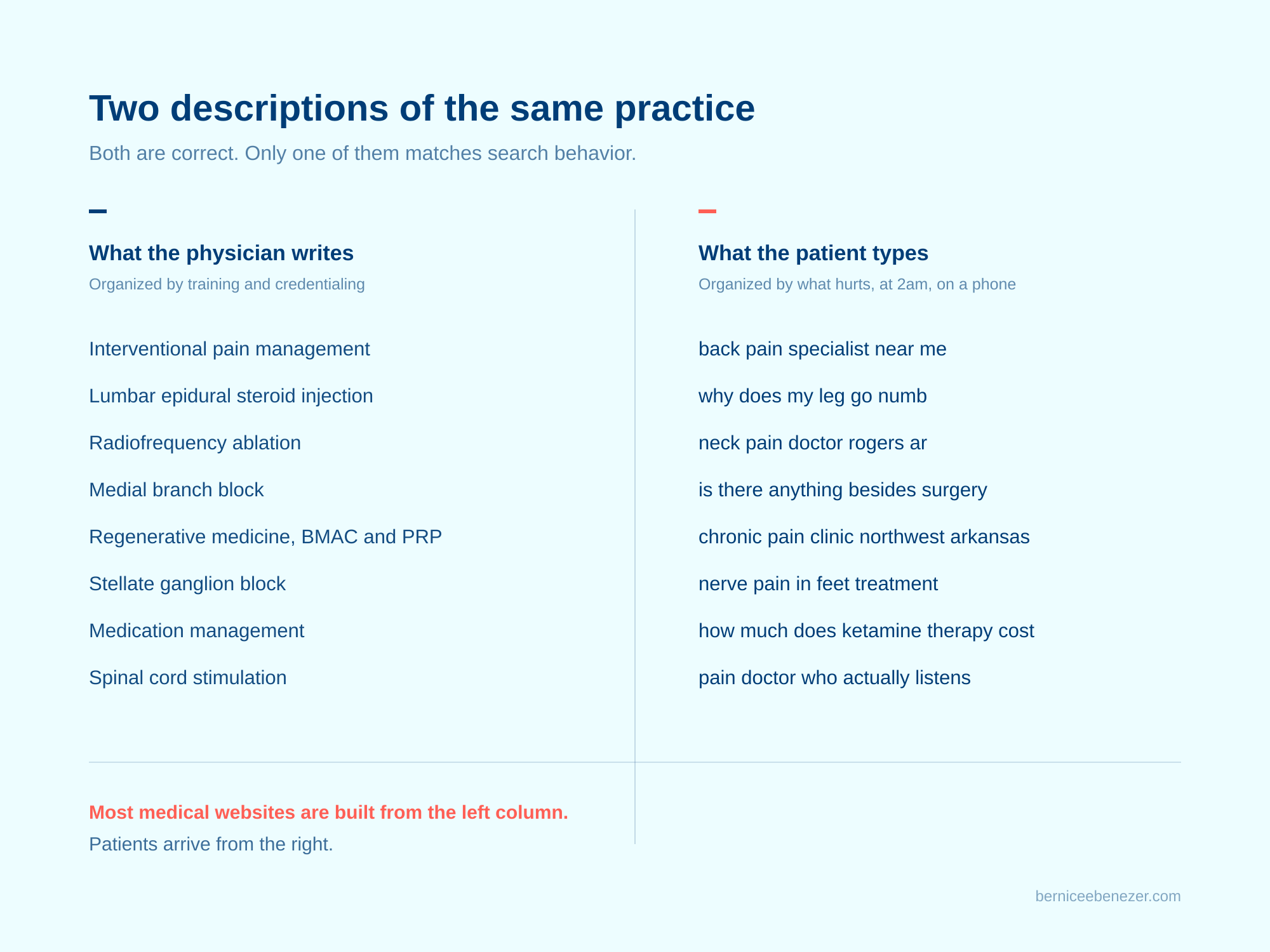
A physician describes a practice by what they are trained to do. A patient describes it by what hurts. Most medical practice websites are built from the first description, which is why they underperform in search and convert poorly once visitors arrive.
I design and build Webflow websites for doctors, specialists, and health practitioners whose name is their credential. Across those projects, the same gap appears almost every time. The physician hands over a list of procedures, modalities, and service lines, organized exactly as it would appear on a credentialing application. The patient, meanwhile, is sitting up at two in the morning typing "lower back pain specialist near me" into a phone.
Both descriptions are correct. Only one of them matches search behavior.
This post covers what actually makes a medical practice website work, including how to structure it around patient search intent, where credentials belong, what website copy is and is not, the compliance limits that govern patient data, how local SEO functions for a practice, what changes when an existing site is being redesigned rather than built from nothing, and what to have ready before a project begins. It is written for physicians planning a new practice website, for established specialists whose current site no longer reflects their work, and for anyone trying to work out why their site produces very few enquiries. If you are specifically at the pre-launch stage, my earlier post on what a specialist physician's website needs to convert patients covers that situation in more depth.
Start with the symptom, not the service line
Patients search for their condition far more often than they search for the treatment that resolves it. Someone with a herniated disc does not type "lumbar epidural steroid injection" into Google. They type "back pain" and some version of their city.
This has a direct consequence for site architecture. A practice website organized purely around service lines captures only the small fraction of visitors who already know what procedure they need. Everyone earlier in the decision process, which is most of the market, lands somewhere else.
The dual entry point
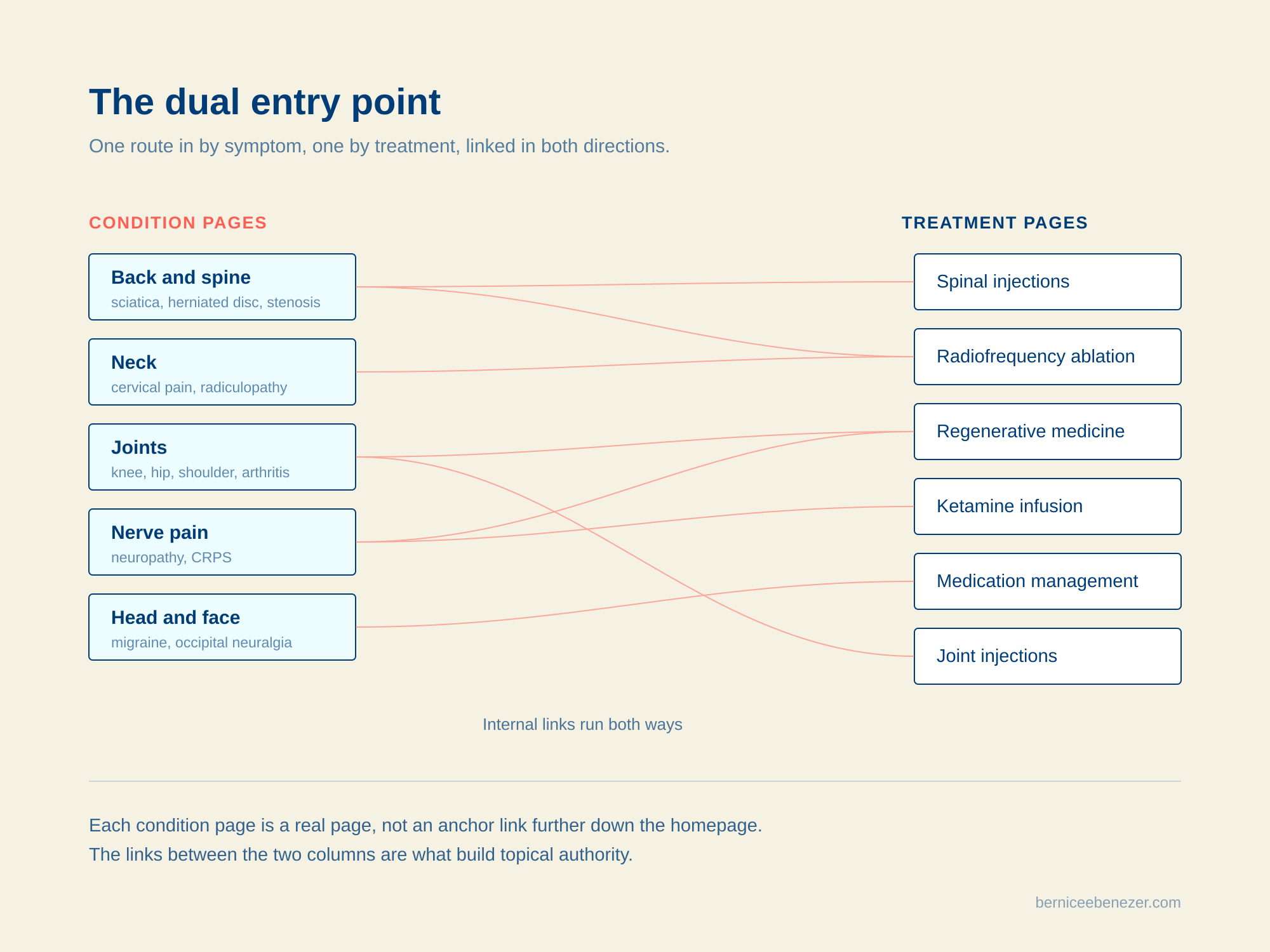
The structure that works is a dual entry point. One route in by symptom or body area, one route in by treatment, and heavy internal linking between the two.
In practice that means a navigation element asking a plain question, something close to "where does it hurt," with clear links to body regions. Back and spine. Neck. Joints. Nerve pain. Head and face. Each of those is a real page with real content, not an anchor link to a section further down the homepage. From each condition page, the patient is routed to the specific treatments that address it, with the clinical reasoning explained in language they can follow.
Why condition pages build topical authority
Two things make this work beyond the obvious usability gain. First, it creates a page that can rank for the condition term, which is the higher-volume search. Second, it builds topical authority, because search engines read the relationship between a condition page and the treatment pages it links to as evidence that the site covers the subject properly.
Skip the interactive body diagram at launch
One caution worth naming. Physicians frequently ask for an illustrated, interactive body diagram at this point. It is appealing, and it is also the most expensive element on the page by a wide margin. A clean set of labeled links performs the same job for search and conversion. The illustration is a refinement to add once the site is earning, not a launch requirement.
Credentials are conversion, not decoration
Board certification and fellowship training are usually buried on the About page of a physician website. They belong in the first screen a visitor sees.
The reason is the decision the patient is making. Chronic pain patients in particular arrive having already been dismissed somewhere. They have seen a general practitioner, possibly several. They have been told to rest, to lose weight, to wait. By the time they reach a specialist website they are asking one question. Is this person actually qualified to help me, or is this another place that will waste my time.
A board-certified anesthesiologist with fellowship training in pain medicine answers that question immediately, but only if the answer is visible. Specifics outperform adjectives here. "Board-certified anesthesiologist, fellowship-trained in interventional pain medicine" does more work than "experienced and compassionate care," which every competing practice also claims. I have written separately about what patients actually read on a surgeon's website before they decide to book, which goes deeper into that first-visit mindset.
Premium without looking like a med spa
There is a related positioning problem that comes up constantly in this field. Practices offering regenerative medicine, ketamine infusion therapy, or similar treatments often want a premium, concierge-level aesthetic. That instinct is sound. The risk is that the visual language of premium healthcare overlaps heavily with the visual language of medical spas, and a physician-led practice offering evidence-based interventional care does not want to be mistaken for one.
The distinction is drawn through restraint rather than ornament. Editorial layouts with real white space. Typography with weight behind it. Credentials and clinical reasoning given prominence over lifestyle imagery. Clinical photography rather than stock images of people smiling while holding their lower back. Design that signals an institute rather than a wellness brand.
Trust elements worth building in
These trust elements are worth building into the structure.
- Board certification and fellowship training, stated specifically and placed high
- A physician biography written for patients rather than for peers
- Clear explanation of the diagnostic process before any treatment is named
- Transparent information on what each treatment involves and what it costs
- Honest framing of outcomes, with no language suggesting cure, reversal, or regrowth
For established specialists, authority comes from curation
For established physicians there is a further point, and it runs against instinct. Authority comes from curation rather than volume.
A surgeon fifteen years into practice may have seventy published papers. Most of them will be residency-era work in fields they no longer practice, which means a complete publication list actively dilutes the specialty they want to be known for. Eight selected publications in the current specialty read as focused expertise. Seventy read as a CV someone pasted onto a webpage.
The same applies to case libraries, speaking history, teaching appointments, and society positions. Outcomes data is worth hunting for here, including unpublished abstracts and conference presentations, which are frequently the strongest material a practice holds and the most consistently overlooked. A curated set that supports the practice's current direction does more than an exhaustive archive, and it is far easier to maintain. The underlying principle, which one surgeon put better than I could, is to let the evidence do the marketing. Published research, technique detail, and real results make the argument on their own, without any of the promotional language that makes patients suspicious of medical websites in the first place.
The Dr. Andrew Chung case study goes into what this looks like when the credentials are genuinely unusual and the challenge is making them legible rather than impressive.
Clinical information is not website copy
This is the most common misunderstanding in medical web projects, and it is worth naming plainly because it causes more delay and budget friction than anything else.
Clinical information is what the physician knows. What a condition is, how it is diagnosed, which interventions are indicated, what the evidence supports. Website copy is that information restructured for a patient who is frightened, in pain, scrolling on a phone, and deciding within seconds whether to keep reading.
The two are not interchangeable. A physician can supply the first in an afternoon. Converting it into the second is a separate discipline involving search intent, heading hierarchy, keyword placement, readability, calls to action, and FAQ structures built around the questions patients actually type.
When a project assumes the physician will supply finished copy, one of two things happens. Either the project stalls for months while a doctor who is simultaneously negotiating a lease and completing credentialing tries to find time to write twenty pages, or the content arrives as clinical notes and the writing has to happen anyway, unplanned and unbudgeted.
Who is responsible for what
Here is the division of labor that works.
- Clinical substance, treatment detail, and evidence come from the physician
- Page structure, headings, and keyword mapping come from the designer
- Patient-facing writing and calls to action come from the designer
- Meta titles, descriptions, alt text, and FAQ framing come from the designer
- Review and approval of all clinical claims rests with the physician
- Regulatory and compliance review of claims language rests with healthcare counsel
The physician remains the source of truth and signs off on everything before publication. What they are not asked to do is write marketing copy for twenty pages while opening a practice.
Content briefs are what make this work
One structural tool makes this far easier, and that is a content brief per page. Before any writing happens, the designer supplies a short document for each page setting out the sections required, their purpose, and the keywords that page is targeting. The physician fills in the clinical substance against that structure. Content arrives usable rather than as an undifferentiated block of notes, and nobody wastes a round. If you are drafting your own content, my free Website Copy Starter Guide works through the same questions.
What a medical website cannot do with patient data
A request that comes up in nearly every medical practice website project is some version of an intake or insurance verification form. The physician wants patients to submit their details before the first call, which is entirely reasonable and saves staff time.
The moment that form asks for a reason for visit, an insurance member ID, or an upload of an insurance card, it is collecting protected health information.
What counts as protected health information
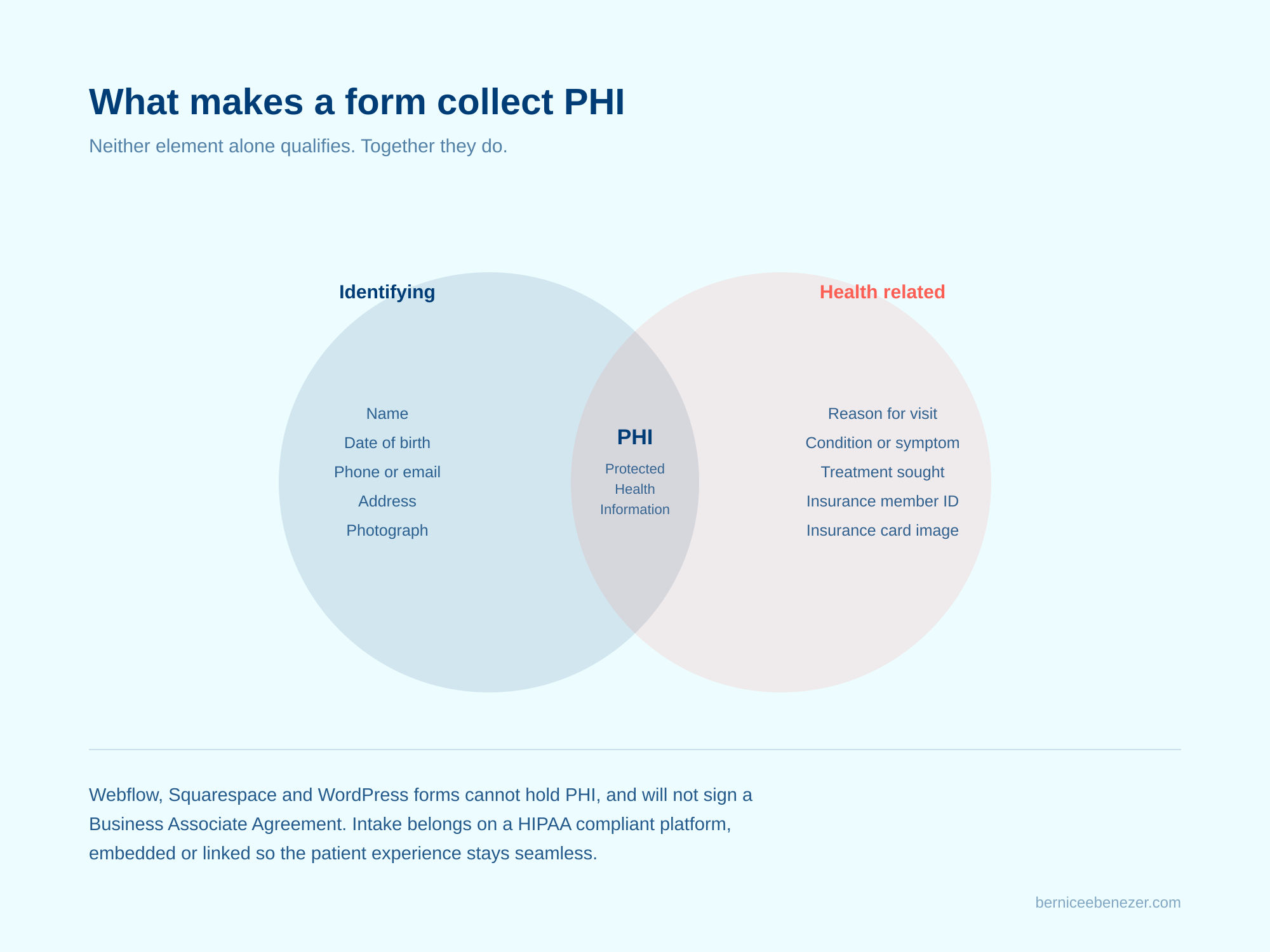
Protected health information, or PHI, is health information that can be tied to a specific individual. It requires two elements. Something identifying, such as a name, date of birth, phone number, or photograph, and something health-related, such as a condition, a treatment, or a reason for seeking care. Neither element alone qualifies. Together they do. The fact that someone is submitting a pain management intake form is itself health information.
Why website platforms cannot handle it
Standard website platforms cannot handle this. Webflow, Squarespace, WordPress forms, and similar tools store submissions in a dashboard and typically forward them by email, neither of which meets HIPAA requirements for encryption and access control. More to the point, those platforms will not sign a Business Associate Agreement, the contract that makes a vendor legally accountable for handling PHI on a provider's behalf.
The correct architecture is straightforward. Patient intake and insurance verification run on a HIPAA compliant third-party platform, embedded or linked from the website so the patient experience stays seamless. The practice holds the Business Associate Agreement directly with that provider. The website platform never touches PHI at any point.
Privacy Policy and Notice of Privacy Practices are not the same document
A related distinction catches many practices out. A website Privacy Policy and a Notice of Privacy Practices are different documents governing different things. The Privacy Policy covers website visitors, meaning cookies, analytics, and contact form submissions. The Notice of Privacy Practices is a HIPAA requirement describing how the practice uses and discloses patient medical records, with mandated content including patient rights, the practice's duties, and a complaints process. It must be provided to patients and posted on the website. No policy generator will produce it. It comes from healthcare counsel or the practice management setup.
For the website policies themselves, I use Termageddon, which generates privacy, terms, and cookie policies and updates them automatically as privacy laws change. I have written more about the legal pages a professional website needs if you want the fuller picture.
Keep analytics away from form data
One further point that is easy to miss during a build. Analytics scripts on pages where PHI is entered have been a genuine enforcement issue for healthcare providers. Tracking should be configured so that no form field values or URL parameters carrying patient data reach the analytics platform.
Intake software is not scheduling software
It is also worth distinguishing intake software from scheduling software, because they are often conflated. Scheduling answers when, covering the calendar, availability, appointment types, and reminders. Intake answers who and why, covering demographics, history, consent, and the reason for visit. Many scheduling tools are not built for PHI. Most electronic health record systems include both, which means the sequencing advice is usually to select the EHR first and then decide what the website needs to connect to.
Local SEO for a practice that serves a region
Most specialist practices draw patients from a region rather than a single town, which produces a predictable request. Build a landing page for each city in the catchment area.
For a practice operating from one location, this is the wrong move. Pages targeting cities where the practice has no physical presence are the doorway page pattern that search engine guidelines specifically address. Four near-identical pages with the city name swapped will underperform, and can actively harm the site. They will also not produce four map listings, because a Google Business Profile requires a real, staffed address.
The three-layer structure that does work
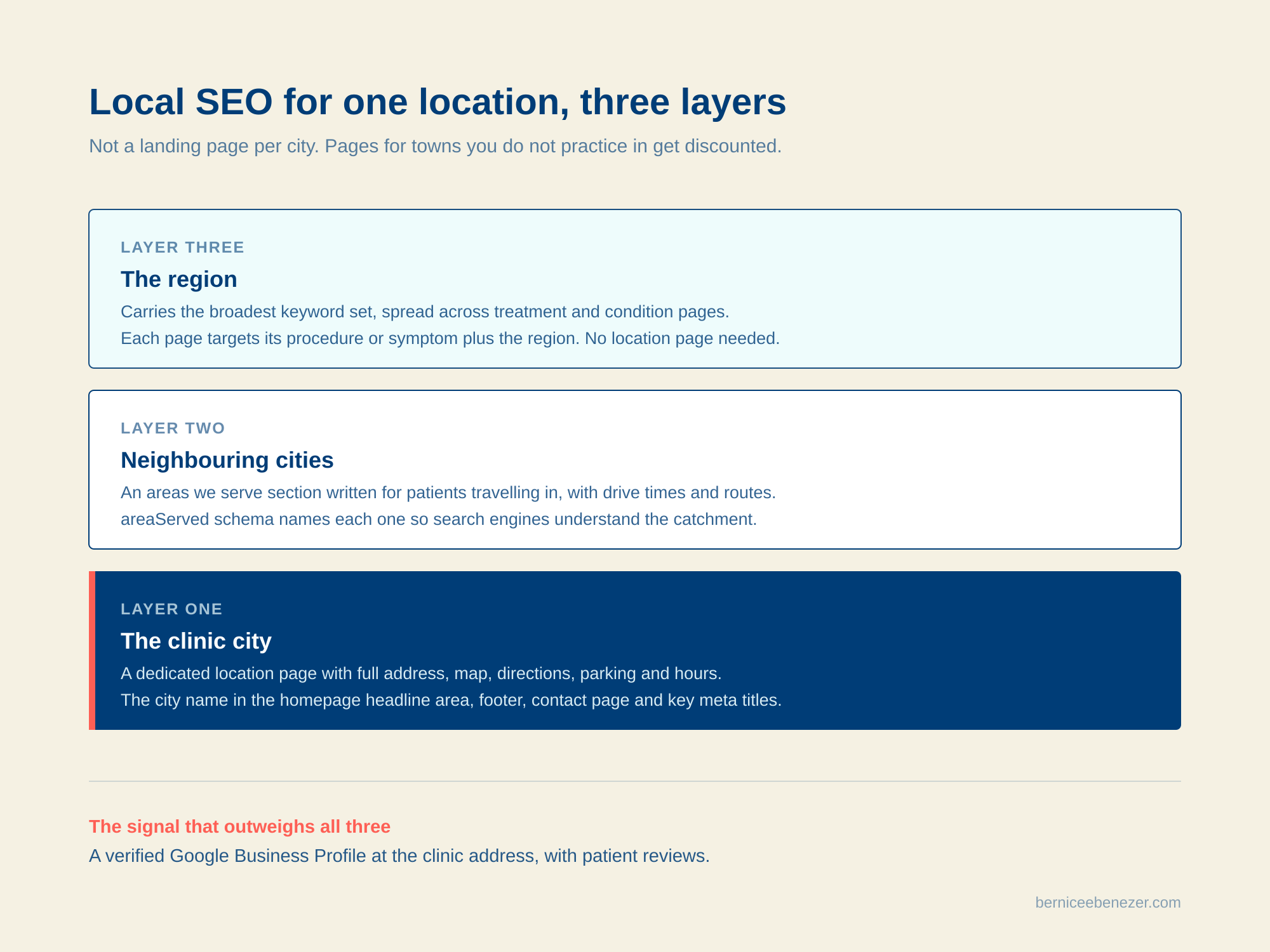
The structure that does work has three layers.
The clinic city receives direct treatment. A dedicated location page carrying the full address, embedded map, directions, parking, and hours. The city name appears in the homepage headline area, the footer, the contact page, and the meta titles of the highest-value service pages.
Neighboring cities are handled through genuine content rather than duplicate pages. An "areas we serve" section written specifically for patients traveling from those towns, with drive times and routes, plus areaServed schema naming each one explicitly so search engines understand the catchment without the site needing a thin page per town.
The region carries the broadest keyword set, distributed across treatment and condition pages rather than concentrated on a location page. Each treatment page targets its procedure plus the region. Each condition page targets the symptom plus the region.
The technical foundation
Alongside that, the technical foundation matters.
- MedicalClinic and Physician structured data with the clinic address
- areaServed schema listing every city in the catchment
- FAQPage schema on service and condition pages
- Consistent name, address, and phone across the site, schema, and every directory listing
- One primary keyword per page, so no two pages compete with each other
- Internal linking from condition pages to the treatments that address them
Why NAP consistency matters more in healthcare
NAP consistency deserves its own note. Name, address, and phone must appear in exactly the same form everywhere. Suite versus Ste. Street versus St. A tracking number on the site that differs from the one on the Google profile. These small inconsistencies are read as signals that the business may not be what it claims, and in healthcare the problem compounds because provider data gets scraped and republished across medical directories constantly.
The ranking signal that outweighs everything else
Now the part that is less comfortable to say and more important than everything above it. For a search like "pain management" plus a city name, the single strongest ranking signal is a verified Google Business Profile at that address with patient reviews. It outweighs on-page structure. A new practice that has not yet signed a lease cannot activate one, and a practice that has just opened has no reviews yet.
The honest expectation for a new domain with no profile, no reviews, and no backlinks is three to six months before meaningful local movement. The foundation built at launch is what shortens that timeline rather than eliminates it. Any practice being promised faster should ask what specifically is going to produce it. I track search performance over time with Semflow, which makes it straightforward to see which pages are actually gaining visibility rather than guessing.
Redesigning an established practice site without losing what it has earned
Everything above assumes a practice being built from nothing. The more common situation is a physician who already has a website, already ranks for a handful of terms, and wants something that reflects where the practice actually is now rather than where it was six years ago.
That project is not a smaller version of a new build. It is a different discipline, because this time there is something to lose.
Start with a Search Console baseline
The first task on a redesign is not design. It is establishing a baseline from Google Search Console covering at least twelve months, showing which pages earn impressions, which keywords the practice already ranks for, and where those positions sit. Established practices are almost always ranking for things nobody planned, and some of those pages carry real traffic. On a recent project, a single services page was producing around twenty-three thousand impressions a year entirely on its own. A redesign that quietly retires that page, or changes its URL without a redirect, throws away years of accumulated authority in an afternoon.
Redirect mapping is the highest-risk task
Redirect mapping is therefore the highest-risk task in the whole project. Every existing URL needs a decision, either kept, merged, or given a 301 redirect to its closest equivalent. The damage from getting this wrong is invisible on launch day and shows up as a ranking collapse several weeks later, by which point the cause is hard to trace.
How excellent design quietly costs rankings
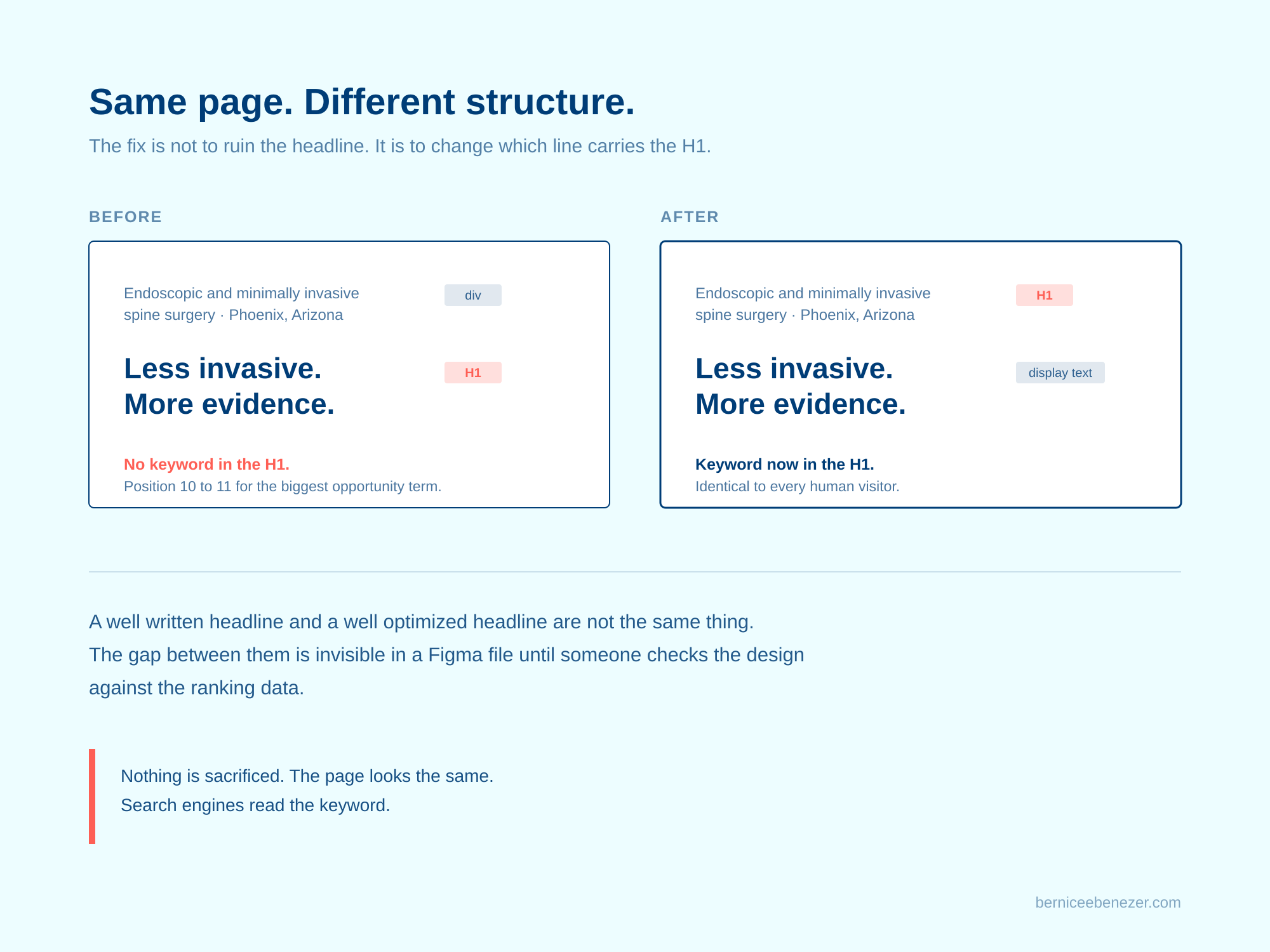
There is a subtler failure mode worth naming, because it catches good designers rather than careless ones.
A redesign can be visually excellent and still cost the practice its rankings, through nothing more than heading structure. A homepage headline reading "Less invasive. More evidence." is strong writing and strong design. It also contains no keyword, which means a practice sitting at position ten or eleven for its single biggest opportunity term has given up the strongest on-page signal it has.
The resolution almost never requires compromising the design. In most cases the keyword already exists on the page, sitting in an eyebrow line above the headline or in the opening paragraph, styled small. Tagging that line as the H1 and styling the headline as display text changes nothing a visitor sees and changes everything a search engine reads. This is the kind of detail that separates a site that looks good from a site that performs, and it is almost always invisible in a Figma file until someone checks the design against the ranking data.
Orphaned keywords and procedure naming
The same check surfaces orphaned keywords, meaning terms the practice should own that have no page to live on. Conditions are the usual casualty. A surgeon's site might have strong procedure pages while back pain, neck pain, sciatica, and herniated disc have nowhere to land, which returns to the first point in this post. Patients search for the condition.
A related naming question surfaces in the same audit. Clinical accuracy and search behavior sometimes diverge, and the page heading has to serve the patient. Almost nobody searches for motion preservation. A great many people search for disc replacement. The page can carry both terms, but the one patients actually type belongs in the heading.
What an established practice already has working for it
What an established practice does have, and a new one does not, is a Google Business Profile with history, existing reviews, accumulated backlinks, and real ranking data to design against. Those are assets. The redesign should be built to protect and extend them rather than starting the clock again.
Practices operating from several locations have one more layer. Each staffed location can hold its own Google Business Profile and deserves its own page with a full address, and the clinic the practice actually works from should never be the one missing from the keyword strategy. After launch, positions are worth watching weekly for the first two months, which is the window in which a redirect problem becomes visible and is still cheap to fix.
Some keyword decisions are clinical, not commercial
Keyword research produces a list. Not every item on that list should be acted on, and the physician is the only person who can make the call.
Three patterns come up repeatedly.
Marketing language the specialty itself avoids
Some terms carry genuine search volume but are regarded as marketing language within the specialty. "Laser spine surgery" is the clearest example. Patients search for it because it has been advertised to them heavily, and plenty of surgeons will not use the phrase because it misrepresents what the procedure actually involves. Chasing the traffic means adopting language the physician's own colleagues would question.
Terms that describe a different qualification
Some terms describe a different qualification. An orthopaedic spine surgeon can rank for searches containing "neurosurgeon," and patients do search that way without understanding the distinction. Targeting it brings in people looking for something the practice does not offer, which is both a conversion problem and a credibility problem.
Places the practice does not actually serve
Some terms describe places the practice does not serve. SEO consultants frequently suggest nearby affluent suburbs regardless of whether the practice has a location there, which returns to the doorway page problem above. It is equally common for a consultant's list to omit the town where the main office actually sits.
The working rule is that the designer brings the opportunity and the physician decides whether it is appropriate to pursue. A keyword list arriving from a consultant is a starting point for that conversation rather than a specification to implement.
Credibility signals in health content
This is also where credibility signals earn their place. A "medically reviewed by" line with full credentials, visible author attribution, and genuine research citations are not decoration. Search engines apply elevated standards to health content, and those signals are read directly.
Cash-pay practices need a different kind of page
A growing number of specialist practices operate partly or entirely outside insurance. Regenerative medicine, ketamine infusion therapy, and membership-based care models are rarely covered, and some physicians are choosing to build their practice on self-pay from the outset.
This changes what the website has to accomplish.
An insurance-based practice can lean on coverage as the implicit answer to cost. A cash-pay practice has to justify its price directly, which means pricing transparency moves from a detail buried on a secondary page to a central element of the site. Patients who are paying out of pocket research harder, compare more, and abandon faster when cost is unclear. Hiding the number does not delay the question, it just moves the patient to a competitor who answered it.
A cash-pay practice website needs several things an insurance-based one does not.
- Clear pricing for each treatment, or at minimum a stated range with what determines where a patient falls in it
- An explanation of what is included in that price, covering consultation, imaging review, follow-up, and the procedure itself
- The reasoning behind operating outside insurance, framed around time with the physician and treatment choices driven by clinical judgment rather than coverage rules
- Prominent treatment of membership or package options, which carry more weight when there is no reimbursement stream
- Payment method information, including financing where it is offered
Mixed insurance and self-pay models
Mixed models need a further layer. A practice credentialed with Medicare but not yet with commercial insurers has treatments whose payment status varies by patient and may change as credentialing progresses. Hard-coding that into page text guarantees the site will be out of date within months. The solution is a payment status field in the content management system, with a defined set of states the practice updates itself as credentialing lands. No developer required, and the site stays accurate.
Do not process patient payments on the website
One thing a practice website should not do is process patient payments directly. Deposits, procedure fees, and membership billing belong in the practice management or billing system where they connect to the patient record and the accounting. A payment button on a marketing site creates a transaction that lives nowhere useful, and depending on what is collected alongside it, can pull PHI into a system with no Business Associate Agreement behind it.
Being found in AI search, not only Google
A meaningful share of my own inbound enquiries now arrive through AI assistants rather than through a search engine results page. Someone asks a language model to recommend a web designer for a medical practice, and a name comes back.
The same shift is happening for healthcare. Patients are asking assistants to explain their symptoms, to tell them which specialist treats a given condition, and to recommend providers in their area. Those answers are assembled from sources the model can parse and trust.
Most of what improves visibility in AI-driven search overlaps with good traditional SEO, which is convenient. A few things matter disproportionately.
- Structured data. MedicalClinic, Physician, and FAQPage schema give machines unambiguous facts about who the practice is, what it treats, and where it operates. This is the most direct signal available.
- Clear question-and-answer content. FAQ sections written around the actual phrasing patients use are readily extracted and cited.
- Specificity over marketing language. Named credentials, named conditions, named procedures, named locations. Vague superlatives carry no information and get passed over.
- Consistency across the web. Matching information on the website, the Google Business Profile, and medical directories builds the confidence needed for a model to repeat a fact.
- Genuine depth on the subject. A site with substantive condition and treatment pages reads as authoritative. A five-page brochure site does not.
Claims language and regulatory limits
There is a compliance dimension here that physicians should hold onto. Marketing claims around regenerative medicine, off-label indications, and outcome statistics are regulated by the FDA, the FTC, and state medical boards. Terms like cure, reverse, and regrow attract scrutiny, and superiority claims of the "best in the region" variety are restricted in physician advertising in many states. Final claims language should be reviewed by healthcare marketing counsel before publication. A designer can build the structure and recommend the phrasing. The physician and their counsel own what is actually asserted.
What to have ready before the build begins
Medical website projects rarely stall on design. They stall on inputs. A physician opening a practice is simultaneously negotiating a lease, completing credentialing, selecting an electronic health record system, and hiring staff. The website waits behind all of it.
For a new practice
Having these assembled before the build starts is the difference between launching in seven weeks and launching in five months.
- Logo files in vector format, meaning .ai, .eps, or .svg. A PNG or a social media avatar is not a logo system, and if the mark was generated rather than designed it may need redrawing before it can be adapted for a website header or favicon.
- Brand colors with hex values, and an honest answer on whether a typeface is actually licensed for web use. Display faces that are uppercase only cannot carry body copy.
- Physician biography, credentials, training history, and a professional headshot.
- Clinical information for each condition and treatment the site will cover, supplied against the content briefs rather than as unstructured notes.
- Confirmed clinic address, which gates the Google Business Profile and therefore most local ranking.
- Selected HIPAA compliant intake platform, with the Business Associate Agreement signed. This is a decision only the practice can make.
- Notice of Privacy Practices from healthcare counsel.
- Pricing for self-pay treatments, or defined ranges.
- Insurance and credentialing status, including which payers are confirmed and which are pending.
- Domain access and any existing account credentials.
Two items on that list are worth singling out. The vector logo files, because discovering mid-project that no usable source file exists converts an adaptation job into a redraw. And the clinical content, because it is the single largest determinant of how long the project takes and the one input nobody else can supply.
Professional photography is the usual gap at launch. A practice that has not opened yet has no clinic to photograph. The workable approach is to launch with carefully selected licensed imagery and build the layout so real photography can drop into defined positions once it exists, rather than delaying launch for a photo shoot that cannot happen yet.
For an established practice redesigning an existing site
An established practice redesigning an existing site needs a different list. Search Console and Google Analytics access, ideally with at least twelve months of history. A full inventory of current URLs. Any keyword research already commissioned. Publications, presentations, and outcomes data in whatever form they exist, including unpublished abstracts, which are frequently the strongest material available. And a decision on which pages are being retired, because that determines the redirect map.
Building a practice website that earns its place
The pattern underneath all of this is a single idea. A medical practice website is not a brochure describing what a physician does. It is the first consultation, held before the patient ever picks up the phone.
A patient arriving at two in the morning with back pain is deciding whether this practice understands their problem and whether this physician is qualified to solve it. Everything in the structure either serves that decision or gets in its way. Symptom-first navigation serves it. Credentials placed high serve it. Clear pricing serves it. A homepage that scrolls endlessly through service descriptions written for other physicians does not.
The technical work matters for the same reason. Structured data, local SEO architecture, NAP consistency, and a content management system the practice can maintain are not line items on an invoice. They are what determines whether the patient finds the practice at all, and whether the information they find is still accurate six months after launch.
I build brand identities and Webflow websites for doctors, specialists, and health practitioners whose name is their credential. For a new practice that usually means the full picture, starting with brand strategy, logo design, and a typography and color system that holds up in print as well as on screen, then moving into patient-facing copy developed from clinical information, condition and treatment architecture, local and AI search foundations, HIPAA-aware form integration, and a content management system the practice owns and controls. For an established practice it often means working from the identity that already exists and adapting it properly for the web.
If you are weighing up who should build it, my post on how to choose a web designer for your practice covers the questions worth asking before you commit to anyone.
Three ways to take this further
Start with the checklist. My free Practitioner Website Checklist gives you a practical framework for reviewing what your current site is and is not doing, section by section.
Get a detailed assessment. My website audit service covers your current site across design, messaging, SEO, and conversion, with specific recommendations rather than general principles.
Talk it through. If you are planning a new practice website, or you have one that is not producing enquiries, book a free discovery call and I will tell you honestly what is working and what is not.
Your patients are already searching by the thing that hurts. Your website should be there when they do.
View other interesting posts




If your expertise has outgrown your online presence, let's talk.
A short call — no pitch, no pressure. I will ask about your work and tell you honestly whether I think I can help.
